Panel technology
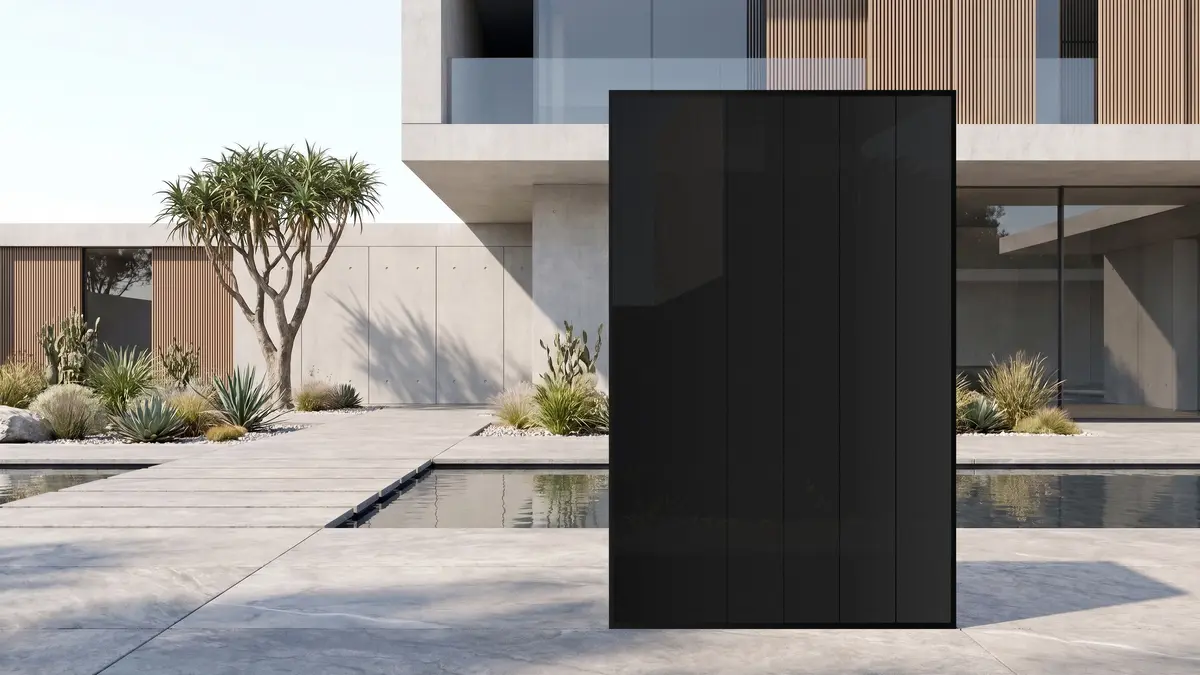
We make three panel technologies, each suited to a different kind of project. Our TOPCon half-cut panels, the T-Class, use N-type cells with a passivated contact layer that turns more of the light they receive into power. Our TOPCon shingled panels, the S-Class, cut cells into smaller strips and overlap them, so more of the panel surface produces electricity. Our Back Contact panels, the E-Class, move all the wiring to the back of the cell, which leaves the front clear to catch light and gives a clean, all-black look on a roof.
The right choice depends on your roof, your budget and how the site is used. Below we explain what each technology is, how it compares with standard panels and where it makes the most sense, from homes to commercial and large-scale projects.
Why are TOPCon half-cut panels preferred for commercial solar systems?
How is Back Contact solar panel different to standard front-contact panels?
Back Contact technology is considered as a key pathway for next-generation high-efficiency silicon solar cells. Unlike front-contact designs, Back Contact cells place both positive and negative contacts on the back of the cell. This innovative structure removes shading caused by frontside metal gridlines, allowing more sunlight to reach the cell active area and reduces the surface recombination rate, leading to higher power generation and improved efficiency. Furthermore, the Back Contact design significantly improves the panel shade management, minimising hotspot formation and enhancing reliable long-term operation.
What is the benefit of shingled technology in large-scale installations?
How do back-contact solar panels support modern solar projects?
How do shingle solar panels compare to standard panels?
Shingle solar panels are different in many ways, they offer a combination of innovative technology and superior construction not seen in standard panels. One-third cut TOPCon shingled-cell technology is used to create high-efficiency solar panels, resulting in better sunlight capture than standard solar panels with lower efficiency. This translates to high power and reliable energy output, reducing electricity costs for customers. Additionally, the bifacial design allows energy generation from both sides of the panel, further optimising output and enabling solar design flexibility.Shingle solar panels are built to last. Using high-quality materials, they feature a glass-glass construction that shields them from harsh weather conditions. The flexible cell interconnections enable the panel to withstand temperature fluctuations, ensuring consistent energy production over the panel's lifespan. A low annual degradation rate helps these panels to maintain their high-efficiency rate over time, whilst a low-temperature coefficient, guarantees optimal solar production even in hot climates. Experienced engineering and clever panel design incorporate strong shade management, offering resilience to a variety of shading scenarios that can detrimentally impact overall energy production. Shingle solar panels offer dependable energy output, durability, and long-term reliability not seen in standard panels.
What are the advantages of using TCL Solar Back Contact panels?
Higher Power Generation Low temperature coefficient of -0.26%/°C that outperforms TOPCon in hot conditions by over 1.3%, an annual degradation rate below 0.35% that retains 88.85% of output after 30 years
Superior Shading Performance Back Contact modules limit power loss to only the shaded area, reducing shading impact by up to 34% and delivering stronger performance in sites with moving or uneven shade.
High Reliability
1) Improved Microcrack Resistance: Full-backside thermal welding design improve the module’s reliability under mechanical loads and temperature fluctuations.
2) Reduced Risk of Hotspot: Low breakdown voltage and uniform breakdown across the entire cell help reduce the dissipated power, protecting the module from hotspots and improving module reliability.
With industry-leading efficiency, intelligent shade management, and exceptional durability, Back Contact technology delivers higher-yield and more reliable modules—setting a new benchmark for solar industry.
Why should I choose TCL Solar Back Contact panels?
Why is advanced solar technology important for homeowners?
What are the benefits of back contact solar technology for homes?
What makes TOPCon solar panels suitable for large businesses?
What are the advantages of TOPCon solar panels for large-scale projects?
How does advanced solar panel technology improve business energy efficiency?
Why is TOPCon becoming popular in industrial applications?
What is TOPCon Technology?
TOPCon, short for “Tunnel Oxide Passivated Contact,” is an advanced solar cell technology that utilizes a N-type silicon base to enhance efficiency and performance.
How would I benefit from choosing TCL Solar TOPCon panels?
TCL Solar TOPCon panels deliver significant benefits, producing more energy through higher efficiency, lower annual power degradation, better performance in high temperatures and low light conditions. They also offer enhanced reliability, and more efficient bifacial production, leading to more power generation per square meter, better value over the long term, and excellent reliability for installations in harsh environments. With superior performance in all operating conditions, TCL Solar TOPCon sets a new benchmark for high-efficiency, future-proof solar technology.
What are the advantages of TCL Solar TOPCon panels?
The advantages of TOPCon panels include:
Higher Efficiency TOPCon cells in mass production can reach efficiencies of over 25%. This results in higher power output and better energy yield for the same installation area.
Lower Degradation TOPCon modules exhibit lower first-year degradation and slower long-term annual degradation, ensuring more consistent energy generation over the panel’s 30-year lifetime.
Enhanced Durability The thin oxide layer provides excellent protection against moisture, temperature fluctuations, and environmental stress, improving long-term reliability and reducing performance loss over time.
Lower Temperature Coefficient With better resistance to heat, TOPCon modules maintain higher efficiency in hot conditions. This is especially valuable in sunny regions or during peak summer months, where traditional panels may suffer larger efficiency drops.
Superior Bifacial Performance TOPCon modules offer a higher bifaciality rate, enabling them to capture more reflected and diffuse light, which in turn boosts total energy yield—especially valuable in commercial and utility-scale installations.
Improved Low-Light Performance Thanks to excellent passivation and reduced electron recombination, TOPCon panels perform better during early mornings, late afternoons, and cloudy days. This extends daily energy production and enhances overall system output.
With superior performance in all operating conditions, TOPCon sets a new benchmark for high-efficiency, future-proof solar technology.
What are the benefits of smaller 1/3-cut cells compared to full-size or half-cut cells?
Smaller 1/3-cut cells significantly reduce internal current and shorten the path electricity must travel within the panel. Lowering the internal current leads to a substantial reduction in resistive losses compared to full-size or even half-cut cells. This directly improves panel efficiency while also lowering operating temperatures—an important factor for long-term performance and durability, especially in hot climates. By integrating the smaller 1/3-cut TOPCon cells with advanced shingled design, shingled TOPCon panels deliver higher efficiency, cooler operation, and outstanding long-term reliability for real-world performance.
Are back contact solar panels better?
Not all solar systems are created equal. Of all the solar panels on the market, back contact panels convert more sunlight into electricity—generating more energy than conventional panels within the same amount of space. With back contact panels you can maximise the value of your available roof space and reduce electricity costs over time.
What are the advantages of TCL Solar shingled TOPCon panels?
The advantages of shingled TOPCon panels include:
Higher Efficiency The smaller 1/3-cut cell design significantly lowers the internal current and shortens the path for the electricity to flow, resulting in lower resistive losses and improving efficiency.
Cooler Operating Temperatures Lower current helps to reduce the power dissipation in the form of heat. This simply means lower cell operating temperature, improving thermal performance in real-world and high-temperature installations.
Extended Panel Lifespan Reduced heat and lower thermal stress help minimize long-term power degradation and improve reliability over the panel’s lifespan.
Improved Shade Tolerance Smaller cells operate more independently, so shading on one area has minimal impact on the rest of the panel, reducing overall power loss in partially shaded conditions.
Enhanced Mechanical Strength Smaller cells experience less mechanical stress, lowering the risk of micro-cracks and improving durability during transport, installation, and operation.
Maximized Active Area The shingled, overlapping cell layout eliminates inactive “dead zones” between cells, ensuring the entire panel surface is used to capture more sunlight and increasing energy production.
Flexible Inter-Cell Connections Advanced flexible interconnections improve resistance to temperature swings, reduce the risk of ribbon failure, and enhance reliability.
Tested beyond industry standards for thermal cycling, shingle panels ensure reliability in the field.
By combining N-type TOPCon cells and shingled design, shingled TOPCon panels deliver higher efficiency, cooler operation, and exceptional long-term reliability—engineered for maximum performance in real-world conditions.
How do TOPCon shingled solar panels improve solar performance?
What is TOPCon Shingled technology?
TOPCon shingled solar technology combines TOPCon (tunnel oxide passivated contact) technology with a shingled cell design to create highly efficient and powerful solar panels. The shingled design overlaps 1/3 cut solar cell strips with a flexible joint, which reduces resistance and improves power output.
What does intelligent shade management in TCL Solar Back Contact technology mean?
One of the great advantages of Back Contact technology is its intelligent shade management. Thanks to the cell’s low breakdown voltage and unique architecture, each cell exhibits a built-in cell-level bypass diode function. In practice, this means a shaded cell can effectively bypass itself, reducing its energy consumption, while preventing major system-level power loss in partial shading. More importantly, this design minimises hotspot formation and supports more reliable long-term operation. For installations with intermittent or uneven shading—whether from vegetation, bird droppings, surrounding buildings, or dust, Back Contact provides a clear performance advantage.
What is back-contact solar cell technology?
Back Contact (BC) solar cells are high-efficiency technology solar cells where both the positive and negative electrodes are placed on the backside of the cell. That means no busbars in the way, covering the front of the panels. This design effectively reduces shading area and enhances the absorption and utilization efficiency of sunlight.
Why are TOPCon residential solar panels becoming popular?
How are shingled TOPCon panels different from standard TOPCon panels?
Shingled technology represents an evolution in solar panel design, combining N-type TOPCon solar cells with an innovative cell design to maximize efficiency, reliability, and real-world performance. In shingled technology, TOPCon solar cells are cut into smaller 1/3 strips and electrically connected in a shingled, overlapping configuration. This design eliminates inactive gaps between cells, increasing energy production and boosting overall panel output. Shingled TOPCon provides a premium solution, offering higher performance and enhanced reliability, particularly beneficial for installations with limited roof space or complex shading challenges.
What does TOPCon mean in solar technologies?
TOPCon (Tunnel Oxide Passivated Contact) technology is one of the most advanced solar cell technologies available today, designed to deliver high efficiency, reliability, and long-term performance. Building on traditional PERC technology, TOPCon introduces an ultra-thin tunnel oxide layer and a passivated contact structure that significantly reduce the electron recombination losses. This means more of the sunlight hitting the panel is converted into clean, usable energy. With its blend of high efficiency, low degradation, and excellent performance in both harsh conditions and low-light environments, TOPCon has rapidly become the preferred choice for residential rooftops, commercial buildings, and utility-scale solar farms aiming to maximize energy production from every square meter.